The Sgian Dubh
How a 'Traditional' Object Informed the Creation of a Modern Object Free from Tradition.
By Leah Faulks
Introduction - A Search for Belonging
National identity is complex. One way it can be measured is through tangible and intangible heritage, the physical objects and non-physical practices that capture the story of a culture (Kelly, 2025). This was clear to me in Scottish national identity, where traditional practices like dance, music, ceremonies and storytelling are just as prevalent as the objects associated with them. The kilt clad highlander, playing the bagpipe while stood in front of the wild Scottish landscape is a well-known image of Scotland.
However, I struggled to find belonging within tangible ‘Scottish’ imagery because of the prevalence of a stylised, stereotyped and sellable version of Scotland that seemed to profit from and exaggerate a traditional image. Tartan, thistles, highland cows and bagpipes have become the face of the Scottish souvenir trade, and this commercial motivation gave me a sense of unease when trying to find my own place within that imagery. It did not represent me, or my feeling of what it meant to be Scottish.
Section 1 – The Sgian Dubh
This feeling of discomfort, and the curiosity of a maker, led me to historical research into Scotland’s tangible and intangible cultural heritage. Through this research I discovered the Sgian Dubh, a small blade associated with the Traditional Highland Dress that is still commonly worn today at ceilidhs and formal events. It had also been impacted by the commercialisation of heritage, with many modern examples sold cheaply in mass-produced designs using recycled motifs. However, I was drawn in by the romantic story of the blade, said to have been a hidden knife, revealed out of courtesy and tucked in the top of the stocking (Hayward & Stott, 2020). I felt this narrative captured a community spirit and hospitality I associated with Scottish identity and so decided to dig deeper into the object.
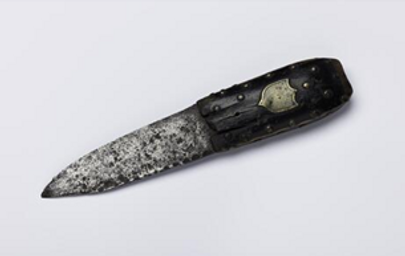
I visited the National Museum of Scotland, where I found the oldest example of a Sgian Dubh on display in their collection, with the museum reference H.LC 49 (see figures 1 - 4).
Figure 1: National Museums Scotland (no date) Sgian Dubh. Figure 2: National Museums Scotland (no date) Sgian Dubh.
Figure 3: National Museums Scotland (no date) Sgian Dubh. Figure 4: National Museums Scotland (no date) Sgian Dubh.
It has a 3-inch-long blade and features a dark wooden handle with metal stud decorations identified as brass at its purchase in 1900:
“Skene-dhu, the blade 3 inches in length and notched on the back, the handle 3 inches in length and ornamented with studs and a small shield of brass, found on the wall-head of an old house at Roslin” (National Museum of Scotland, 1900).
This tells us that Sgian Dubh H.LC 49 has been part of the museum collection for 125 years, perhaps being purchased not long after its ‘discovery’ at an old house in Roslin (a village in Midlothian).
Little else is recorded about the story of this Sgian Dubh, so this essay will explore the broader social and political position of objects of Scottish national identity in society and speculate on how this may have impacted the journey of H.LC 49. It can be assumed that this journey began with its creation and use, followed by its ‘discovery’ and the decision of the Society of Antiquities to purchase it for the collection. It then entered a period of preservation in the museum. Sgian Dubhs outside the museum continued to develop, whereas H.LC 49 remained as it was in 1900.
I approached this research with the goal of developing my understanding of what made this Sgian Dubh so different from modern commercial examples, and through this find how to achieve a tangible object authentically representing Scottish identity. I speculated that through developing a “felt intimacy” with H.LC 49 (Harries, 2025) I could understand its story and discover knowledge applicable to the creation of my own Sgian Dubh that represented my feelings of belonging in Scottish identity.
Section 2 – The Sgian Dubh Origins
To understand the story of this object, I looked first to establish its origins and function when it was created.
The Sgian Dubh H.LC 49 seems at first to be an 18th century object due to its placement within a
Jacobite context in the museum, and the label next to it that reads:
“Highland sword, pistol and dirks, 18th century. These are typical weapons of the sort outlawed by the various disarming acts which followed the unsuccessful Jacobite risings of 1715 and 1745. The acts were often widely disregarded” (Scotland Transformed, 2025).
However, this label does not in fact reference H.LC 49, which suggests that it does not have an exact date. It is known to have been acquired at the end of the 19th century (National Musuem of Scotland, 1900), but its implied 18th century origin cannot be confirmed without further research.
There are many theories about how the Sgian Dubh came to be, many of which suggest the origins of the blade to be around the 18th century. This potentially places H.LC 49 at the very early stages of Sgian Dubh evolution.
A common narrative with modern sellers traces the Sgian Dubh back to the courteous action of revealing a hidden blade like the Sgian Achlais (figure 5) when gathering with friends during the clan era (Hayward & Stott, 2020). This placement in the top of the stocking developed into the Sgian Dubh (Grancsay, 1931) and contributed to its name which translates as ‘black knife’, (suggesting a hidden or secret knife) (MacCorkill, no date). Some cite the Gralloch Knife, Highland Dagger and Drovers Knife as having developed into the Sgian Dubh when they standardised in the uniform of the Highland Regiments in the 19th century (Macdonald, no date) (Cannan, 2009).
Figure 5: National War Museum (no date) Sgian Achlais on display in the National War Museum.
There is a great diversity of interpretations on the origin story of the Sgian Dubh. This is influenced by the lack of documented evidence on this object until the 19th century (Grancsay, 1931), when a painting of Colonel Alastair Ranaldson Macdonell of Glengarry (1773 - 1828) by Sir Henry Raeburn (figure 6) features the blade (National Galleries Scotland, no date). The first written mention of Sgian Dubhs comes in Regimental History of the Regiment Vol II, 1816 - 1898 (Ferris-Lay, 2017, p. 58). There are examples of Sgian Dubhs with suggested dates in the late 18th century (figures 7 and 8) (Ferris-Lay, 2017) but these could be explained as predecessors to the Sgian Dubh before it formalised, or during the transition period from utility blade into this new decorative identity and placement. The similarities in handle shape, blade type and size between Ferris-Lay’s early Sgian Dubh in figure 8 and the Gralloch knife and Drover’s knives supports this conclusion.
Figure 6: National Galleries Scotland (no date) Figure 7: Ferris-Lay (2017) Sgian Dubh Figure 8: Ferris-Lay (2017) Sgian Dubh
Colonel Alastair Ranaldson Macdonell of Glengarry. Example. Example.
The brass studs and shield of H.LC 49 set it apart from the tools that came before it, suggesting a move towards the decorative function of later Sgian Dubhs. The flat back of the piece supports the fact that H.LC 49 was worn against the leg. Its ergonomic shape and simple decoration does resemble some of Ferris-Lay’s examples of proposed early Sgian Dubhs. It has less resemblance to the utility blade examples, apart from the clipped blade shape. Perhaps therefore, H.LC 49 is an early 19th century example of a true Sgian Dubh.
So, when H.LC 49 was first made and used it was a practical tool that fulfilled the needs of its user (Fraser, C., T., 2016). Its form and decoration suggests that it was worn in the top of the stocking as an early Sgian Dubh, as seen in the example of Glengarry (figure 6). Its clipped blade suggests it evolved from earlier utility blades, and its decorative similarities with late 18th century Sgian Dubhs supports its creation being from around that period. H.LC 49 may have been weapon or cutting tool, with the added function of a decoration to suit the needs of its owner. This was a personal, functional and decorative object.
Section 3 – An Object in Decline
Understanding the early identity of H.LC 49 can be broadened by looking at the society it was made and used in. It holds an interesting position as a ‘Scottish’ object after the Jacobite Uprisings against the Act of Union that had joined Scotland and England. These uprisings, first in 1715 and later in 1745, had a profound impact on the attitude of the English power towards Scottish objects that represent national identity (National Library of Scotland, no date). This is evidenced by the 1746 Act of Proscription (National Museum of Scotland, no date) that suppressed Scottish objects. This move came alongside changes in law that suppressed the political powers of clan chiefs and the ability of Scots to contribute to the politics of Britian (Scotland Transformed, 2025). What is clear from these actions is the governing power was uncomfortable with the rebellious nature and independent identity of the Highlands of Scotland and aimed to suppress their influence and sense of cultural individuality.
The Sgian Dubh at the time was considered the weapon of a ‘ghillie’, associated with the lower class (Scobie, 1921). The 1746 Act of Proscription was not policed fairly, with the upper class being permitted to carry on the wearing of Highland dress and only the lower class punished (UK Parliament, 2021). The 1746 Act of Proscription was repealed by 1782. This could suggest therefore that H.LC 49 belonged to a wealthy figure able to punishment or was created after 1782 when the Sgian Dubh was no longer prohibited.
Even if H.LC 49 was created after 1782, it would have been impacted by the aftermath of this negative sentiment. Multiple factors, including the limiting laws on Scotland and the start of the industrial revolution contributed to the overall decline of Scottish Highland traditions (Cannan, 2009) including the wearing of the Sgian Dubh.
This leads to a question: If Sgian Dubhs and other objects of Scottish identity were in decline after their persecution by the Act of Proscription, why was H.LC 49 considered valuable enough for purchase by the Society of Antiquities in 1900?
Section 4 – Changing Attitudes
H.LC 49 started as a decorated tool that had fallen out of favour after the Jacobite Uprisings of the 18th century. What changes occurred in societies perception of Scottish objects for it to be considered worth purchasing in 1900?
Through the 18th and 19th century, a new sentiment towards Scottish objects was brewing. The Scottish culture that had previously been viewed as savage began to be viewed as romantic. The (since disproved) works of Ossian (National Library of Scotland, 2019) and writers like Sir Walter Scott influenced the popularity of this shift towards romanticism (Bucciantini, 2018). This process became even more prominent with the reign of Queen Victoria from 1837 to 1901. Her high opinion of Scottish Highland culture contributed to it becoming fashionable with Victorians. In fact, Victoria’s purchase and decedent and Scottish themed decoration of Balmoral had such an impact that her romantic Scottish ideals became known as ‘Balmorality’ (Bucciantini, 2018, p. 135).
Bucciantini describes the impact of this romantic attitude:
“With the passage of time fact becomes memory and allows for the formation of nostalgia and myth. Myth can then be integrated into the story of the nation, the “romantic past” indispensable to the formation of national ideals” (2018, p.141).
Bucciantini is suggesting that, with time passing from the tumultuous Jacobite Uprisings, the facts of Scottish history gave way to nostalgic stories and romantic retellings. These narratives became so popular that they were soon engrained in the idea of Scotland and believed as truth. This concept is supported by the theory of invented tradition.
‘Invented tradition’ is a set of ritual or symbolic practices with written or tacit rules that aims to teach a set of values or behaviours by repetition (Hobsbawm and Ranger, 1983, p. 1). There is often an implied continuity with historic traditions to validate the invented one. Invented traditions are often believed to be ancient while in fact being modern, dressed up to look like traditions of old. Trevor-Roper proposes that this concept of invented tradition has greatly impacted the perception of Scottish history and culture today, much of which can be traced back to romanticism (Hobsbawm and Ranger, 1983, pp. 15 - 41).
Due to influences like the romantic works of Ossian and Sir Walter Scott, the taste of Queen Victoria, and Scotland’s growing positive influence for the United Kingdom’s industrial economy, the world’s perception of Scottish history changed. With this change in attitude and narrative, relatively modern objects of national identity were given new narratives of rich and long-lasting tradition. For example, the kilt (called the philibeg or small kilt), which is now considered the cornerstone of Scottish traditional dress, was in fact invented in 1727 by an Englishman to improve the efficiency of his Scottish millworkers (Hobsbawm and Ranger, 1983, p. 22). The modern kilt is first seen pictured in the painting of Colonel Alastair Ranaldson Macdonell of Glengarry (1773 - 1828) (figure 6), which is the same painting that pictures the first Sgian Dubh. If the kilt, the most recognisable of modern Scottish symbols, is invented tradition, then the authenticity of its accompaniments must be treated as equally fictitious.
The impact for H.LC 49 is clear. Its origins were in a period of flux for the presentation of Scottish national identity. The practical tools and clothes of old had fallen out of favour and were soon being rebranded to fit a Victorian perspective of Scotland. Sgian Dubhs were no longer practical tools, made for the personal needs of the user, but objects of decoration used to make the wearer look ‘authentically Scottish’, like Glengarry in his painting.
Nowhere is this change in perception clearer than in the Highland Societies of the era. These groups centred around the celebration and preservation of Highland traditions (National Galleries Scotland, no date). They were set up not just in Scotland, but in England and across the world due to in part to the emigration of Scots after the Highland clearances in the 18th century (Britannica Editors, 2025). Several of these societies produced books that documented their activities and research on Highland tradition (North, 1881). The information in these publications was well-researched but came from a strong romantic bias and featured considerable influence from invented tradition, as was common in the 19th century. Within one book, produced by the London based Society of the True Highlanders in 1881, pipers are illustrated wearing Sgian Dubhs tucked in their stockings (figure 9) (North, 1881). Like Colonel Alastair of Glengarry, members of these societies engaged in Highland traditions to feel a connection to national identity. This illustration demonstrates the Sgian Dubh’s inclusion within this portrayal of Scottish identity. This suggests that attitudes towards H.LC 49 would have shifted to a far more positive, though imagined, perception by the end of the 19th century, especially in England.
Figure 9: Society of the True Highlanders (1881) Pipers.
Another demonstration of the change in perception and role of the Sgian Dubh in the 19th century is seen in their inclusion within the uniform of the Highland Regiments. Many examples of regimental Sgian Dubhs are available from the 18th and 19th centuries, and from Scottish regiments around the world (figure 10 and 11). Their official inclusion in these regiments, a force tied to the English crown, gave the Sgian Dubh further authenticity in its status as a presumed traditional object, and demonstrates the change in English attitudes towards the Scots and their objects. The standardisation of their appearance was likely solidified at this point too, influenced by military tastes and inclusion within a uniform.
Figure 10: National Museums Scotland (no date) Figure 11: National Museums Scotland (no date)
Officer’s Sgian Dubh. Regimental Sgian Dubh.
What can be concluded therefore, is that between its creation in the late 18th or early 19th century and its purchase at the start of the 20th century, the position of the Sgian Dubh in society changed drastically. It was no longer a personal tool. It was now an object of invented tradition, Scottish myth and legend. Its romantic narrative was carried by popular opinion, Highland societies and official recognition in the Highland regiments. Therefore, the Sgian Dubh H.LC 49 was perhaps purchased because it now had a far richer narrative of national identity and belonging than it did when first created, despite the exaggeration of these claims.
Section 5 – Comparisons
H.LC 49 started as a humble tool that had fallen out of favour after the Jacobite Uprisings of the 18th century. It was then given new identity through invented tradition and romanticism in the 19th century, which led to its purchase as part of the museum collection.
Its journey as a used object may have ended at its purchase in 1900, but H.LC 49 continues to influence Sgian Dubhs today. Many modern commercial Sgian Dubhs owe their design inspiration to Sgian Dubhs from the 18th and 19th centuries. Tastes in fashion may have shifted, but the desire for ‘authenticity’ in objects of heritage like Sgian Dubhs means that older styles are often reused.
Features of H.LC 49 like the barrel shaped handle, bog oak wood, a central crest and stud decorations all feature prominently in Sgian Dubhs today, as seen in figures 12, 13 and 14. However the modern Sgian Dubhs likely reference the regimental styles of the Sgian Dubh (figure 10 and 11) more than older examples like H.LC 49, which is demonstrated by the clear similarities between figures 11 and 13.
Figure 12: The Sgian Dubh Company (no date) Figure 13: Art Pewter (no date) Regimental Figure 14: The Sgian Dubh Company. (no date)
Cullen Thistle Daywear Sgian Dubh. Sgian Dubh. Bog Oak Arisaig Sgian Dubh.
Apart from a visual inspiration for modern Sgian Dubh designs, the main function of H.LC 49 today is an educational tool, a relic of a certain time in Scottish history. This is however, as established, often a warped and romanticised version of history, reinforced by the lack of actual documentation about H.LC 49 in its display (Scotland Transformed, 2025).
After this research, I reconsidered my original misconception that H.LC 49 was ‘more authentic’ than modern Sgian Dubhs. Both are an example of using an object to fit a set of values and needs for the user and communicate invented tradition in the modern day without thorough research. This led me to consider my response to this new understanding.
Section 6 – The Response
I began this investigation with a sense of discomfort with the inauthentic nature of commercial Scottish culture. I thought that by studying H.LC 49, I would understand what made it so different from the commercial Sgian Dubhs I saw today and apply this knowledge to the creation of my own Sgian Dubh that represented my personal feelings of belonging in Scottish identity. It could be proposed that I was doing exactly what Ossian, and the Victorian romantics did all those years ago. I wanted to represent my values and feelings of national identity and simply chose an object (H.LC 49) to fabricate a narrative that supported these values.
However, with this understanding, I realised that I could choose to react differently to Ossian. The mythical power of H.LC 49 as an authentic Scottish relic was lifted when I understood that it was, in many ways, a fictional object (Hollis, 2020). I now viewed H.LC 49 as a romantic, stylised version of utility blades that had come before, made by an individual to suit their personal needs and the popular fashion of the time. This was something I could honour. Understanding this narrative and returning to this original attitude could allow me to create something that was different to the commercial Sgian Dubhs of today. I could create a Sgian Dubh that was true to me, rather than true to an imagined history. Freed from the pressures and rules of an invented tradition, the object I created could follow the style and rules it chose and reflect the journey of understanding I had been on.
I therefore decided to design a Sgian Dubh that honoured the object that had taken me on this journey of discovery. The shape of H.LC 49 would be abstracted through loose, free drawings that referenced freedom from tradition and captured my own taste and creative intuition. 3D modelling would be used to capture this new form, which would then be 3D printed. This in turn could be CNC milled into wood and cast into metal and glass. These decisions reflected rebellion against the rules I had once believed as traditions.
I approached the craft of this Sgian Dubh with a new manifesto. As a young woman, I could wear a digitally fabricated, non-functional, contemporary reimagining of a Sgian Dubh from the National Museum of Scotland tucked into my Doc Marten boots with a kilt at a ceilidh. I could do this with a feeling of comfort and certainty because I knew that the traditions that spoke against these things were in fact themselves invented. I found belonging in self-expression through making my own experience of Scottish identity.
List of Figures
1 - 4 National Museum of Scotland (no date) Sgian Dubh. [online image]. Available at: https://www.nms.ac.uk/search-our-collections/collection-search-results?entry=15426 (Accessed: 28 October 2025).
5 National War Museum (no date) Sgian Achlais on display in the National War Museum. [drawing by author].
6 National Galleries Scotland (no date) Colonel Alastair Ranaldson Macdonell of Glengarry. [online image]. Available at: https://www.nationalgalleries.org/art-and-artists/5300/colonel-alastair-ranaldson-macdonell-glengarry-1771-1828 (Accessed: 28 October 2025).
7 - 8 Ferris-Lay, M. (2017) The Sgian Dubh. [photography] Farnham Common. Production by Dave Watson Solutions.
9 North, C. H. M. (1881) The Book of the Club of the True Highlanders. The Club of True Highlanders. Vol 2. [scanned illustration]. Available at: https://www.electricscotland.com/history/club/truehighlanders02.pdf (Accessed: 02 December 2025).
10 National Museums Scotland (no date) Officer’s Sgian Dubh. [online image]. Available at: https://www.nms.ac.uk/search-our-collections/collection-search-results?entry=37233 (Accessed: 28 November 2025).
11 National Museums Scotland (no date) Regimental Sgian Dubh. [online image]. Available at: https://www.nms.ac.uk/search-our-collections/collection-search-results?entry=39308 (Accessed: 02 December 2025).
12 The Sgian Dubh Company (no date) Cullen Thistle Daywear Sgian Dubh. [online image]. Available at: https://www.thesgiandubhcompany.com/item/439/sgiandubh/Cullen-Thistle-Daywear-Sgian-Dubh.html (Accessed: 02 December 2025).
13 Art Pewter (no date) Regimental Sgian Dubh. [online image]. Available at: https://artpewter.co.uk/sgian-dubhs/sdr-regimental-sgian-dubh?limit=100 (Accessed: 02 December 2025).
14 The Sgian Dubh Company (no date) Bog Oak Arisaig Sgian Dubh. [online image]. Available at: https://www.thesgiandubhcompany.com/item/650/sgiandubh/Bog-Oak-Arisaig-Sgian-Dubh.html (Accessed: 02 December 2025).
Reference List
Britannica Editors (2025) Highland Clearances. Encyclopedia Britannica. Available at: https://www.britannica.com/event/Highland-Clearances (Accessed 03 December 2025).
Bucciantini, A. (2018) Exhibiting Scotland: Objects, Identity, and the National Museum. University of Massachusetts Press.
Cannan, F. (2009) Scottish Arms and Armour. Oxford: Shire Publications Ltd.
Ferris-Lay, M. (2017) The Sgian Dubh. Farnham Common. Production by Dave Watson Solutions.
Fraser, C., T. (2016) ‘Foreward’ in Ferris-Lay, M. (2017) The Sgian Dubh. Farnham Common. Production by Dave Watson Solutions.
Grancsay, S.,V. (1931) ‘A Stocking Knife Associated with James II of England’, The Metropolitan Museum of Art Bulletin, 26(6), pp. 146-147. Available at: https://www.jstor.org/stable/3256129 (Accessed: 25 October 2025).
Harries, J. (2025) ‘A Proliferation of Relics’ [Recorded lecture]. DESI112022025-6SS1SEM1: Exploring Critical Making. University of Edinburgh. 20 November. Available at: https://media.ed.ac.uk/media/1_l26jtvqs (Accessed: 28 November 2025).
Hayward & Stott (2020) The Sgian-Dubh. Available at: https://www.haywardandstott.com/the-sgian-dubh/ (Accessed: 28 November 2025).
Hobsbawn, E. and Ranger, T. (1983) The Invention of Tradition. Cambridge University Press.
Hollis, E. (2020) ‘Objects and Stories’ [Recorded lecture]. DESI111642025-6SV1SEM1: Objects of Desire. University of Edinburgh. 12 November. Available at: https://media.ed.ac.uk/media/hollis+objects+of+desire+1A+unicorns+and+grails/1_5vo89xcu (Accessed: 28 November 2025).
Kelly, J. (2025) ‘Narrative Craft’ [Recorded lecture]. DESI112022025-6SS1SEM1: Exploring Critical Making. University of Edinburgh. 18 September. Available at: https://media.ed.ac.uk/media/1_hr02opkz (Accessed: 28 November 2025).
MacCorkill, N. A. (no date) The History of Sgian Dubh. Available at: https://www.gaelicthemes.com/the-history-of-sgian-dubh/ (Accessed: 01 December 2025).
Macdonald, P. (no date) The Sgian Dubh and Scottish National Dress. Available at: https://www.thewhiteroseguild.com/the-sgian-dubh-and-scottish-national-dress-the-facts/ (Accessed: 28 October 2025).
National Galleries Scotland (no date) Members of the Highland Societies. Available at: https://www.nationalgalleries.org/art-and-artists/49321 (Accessed: 02 December 2025).
National Galleries Scotland (no date) Sir Henry Raeburn - Colonel Alastair Ranaldson MacDonell of Glengarry. Available at: https://www.nationalgalleries.org/art-and-artists/5300/colonel-alastair-ranaldson-macdonell-glengarry-1771-1828 (Accessed: 28 October 2025).
National Library of Scotland (no date) Jacobites: A Timeline. Available at: https://www.nls.uk/collections/stories/scottish-history/jacobites-timeline/ (Accessed: 28 October 2025).
National Museum of Scotland (no date) Jacobites and tartan: Symbolism and Style. Available at: https://www.nms.ac.uk/discover-catalogue/jacobites-and-tartan-symbolism-and-style (Accessed: 26 October 2025).
National Museum of Scotland (no date) Sgian Dubh. Available at: https://www.nms.ac.uk/search-our-collections/collection-search-results?entry=15426 (Accessed: 28 October 2025).
National Library of Scotland (2019) Ossian. Available at: https://digital.nls.uk/learning/scottish-enlightenment/ossian/ (Accessed: 28 November 2025).
National Museum of Scotland (1900) ‘Purchases for the Museum and Library’, Proceedings of the Society, May 14, 1900. pp. 436. Available at: https://journals.socantscot.org/index.php/psas/article/view/6796/6765 (Accessed: 28 October 2025).
North, C. H. M. (1881) The Book of the Club of the True Highlanders. The Club of True Highlanders. Vol 2. Available at: https://www.electricscotland.com/history/club/truehighlanders02.pdf (Accessed: 02 December 2025).
Scobie, I. H. M. (1921) ‘Highland Military Dress. A Short Historical Review’, Journal of the Society for Army Historical Research, 1(2), pp. 44-55. Available at: https://www.jstor.org/stable/44219072 (Accessed: 28 October 2025).
Scotland Transformed (2025) [Exhibition]. National Museum of Scotland.
The National Archives (no date) Laws to Control Scotland. Available at: https://www.nationalarchives.gov.uk/education/resources/jacobite-1745/laws-control-scotland/ (Accessed: 28 October 2025).
UK Parliament (2021) ‘The Disarming Acts, Myth and Reality’, Parliamentary Archives: Inside the Act Room, 23 April. Available at: https://archives.blog.parliament.uk/2021/04/23/the-disarming-acts myth-and-reality/ (Accessed: 28 November 2025).
West Highland Museum (no date) Victoriana. Available at: https://www.westhighlandmuseum.org.uk/victoriana/ (Accessed: 29 October 2025).